By William Kwok, Ed.D.
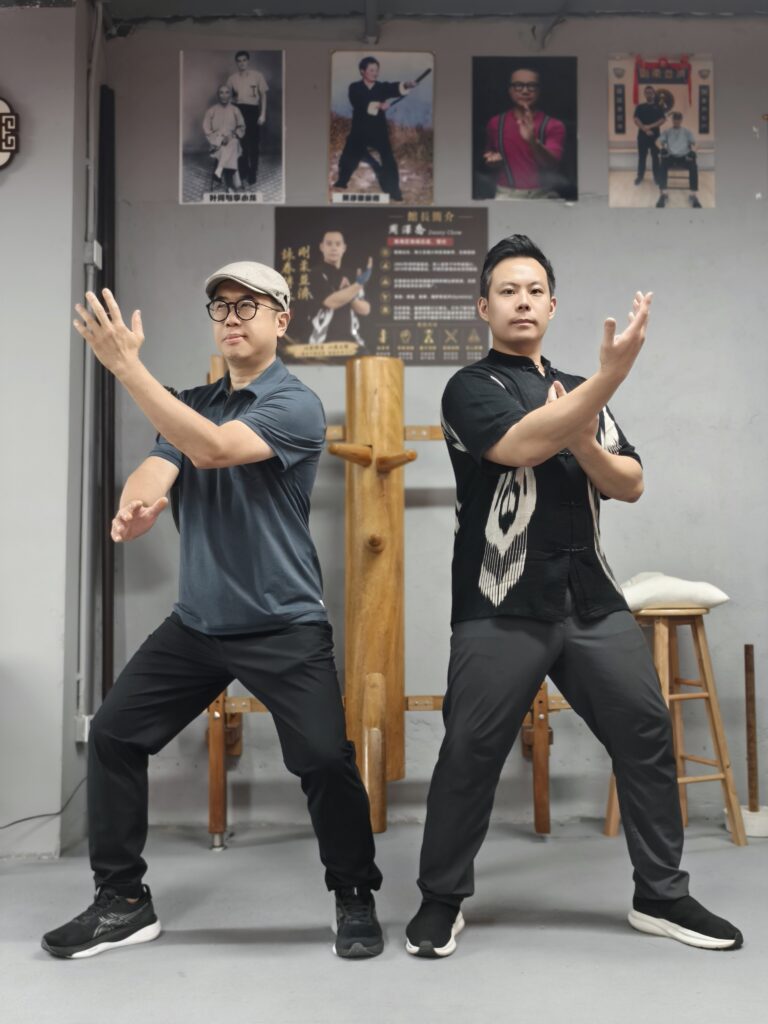
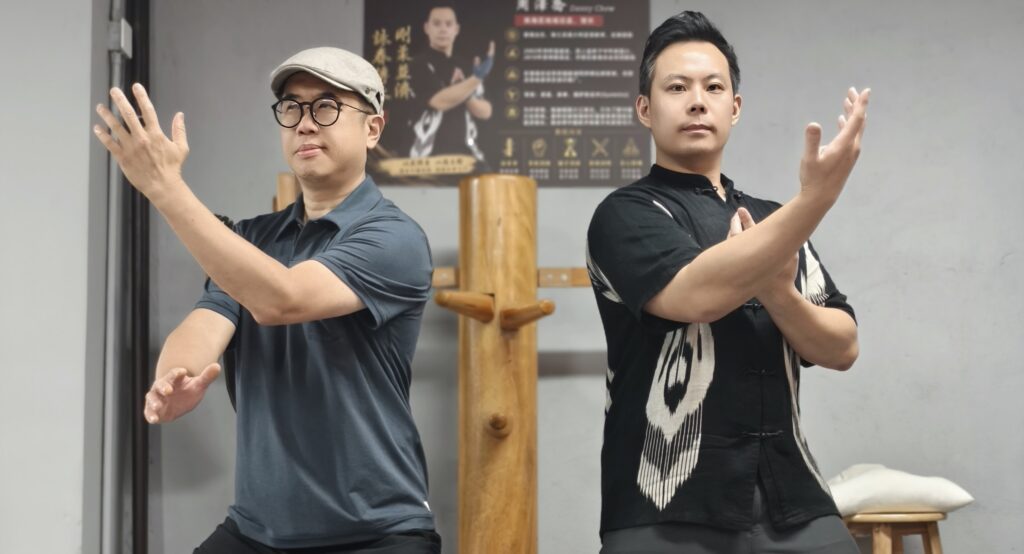
On a recent visit to Zhuhai, China, I stood inside my kung fu brother Danny Chow’s new Practical Wing Chun academy. It was the first time I had seen him in a place that was entirely his own.
I had known Danny for more than twenty years. We had trained together, tested techniques and ideas with each other, disagreed over details, changed our minds, and returned to the same questions more times than I could count. Yet standing there on his training floor, I found myself looking at him a little differently.
Every martial artist remembers his teacher. Teachers give us direction, principles, correction, and a path to follow. But over a lifetime of training, there is often someone else who shapes our development in a different way. It may be the person who keeps standing across from us in training, willing to test an unfinished idea, tell us when it does not work, and keep growing alongside us.
For me, that person has been Danny.
Different Roads, Same Hands
Danny and I came to Practical Wing Chun from very different directions. I am thirteen years older than Danny, but he had started Practical Wing Chun a year before I did. By the time I found the system, I had already spent many years studying different martial arts and was teaching traditional Taekwon-do. I arrived with habits, assumptions, and ways of understanding movement shaped elsewhere.
Danny had no such background. Practical Wing Chun was his first martial art. While I was learning something new through the filter of what I already knew, Danny was building his martial arts foundation from the ground up.
Around the time I first got to know him, Danny was studying at university in Switzerland and had only been training in Practical Wing Chun for a few years. During that period, while traveling in Europe, he was attacked on more than one occasion. In one incident, he had to defend himself against three men and managed to get away safely.
What stayed with him was not the idea that he had won a fight. It was the realization that something practiced inside a training hall could suddenly matter when there was no instructor watching, no agreed rules, and no certainty about what would happen next.
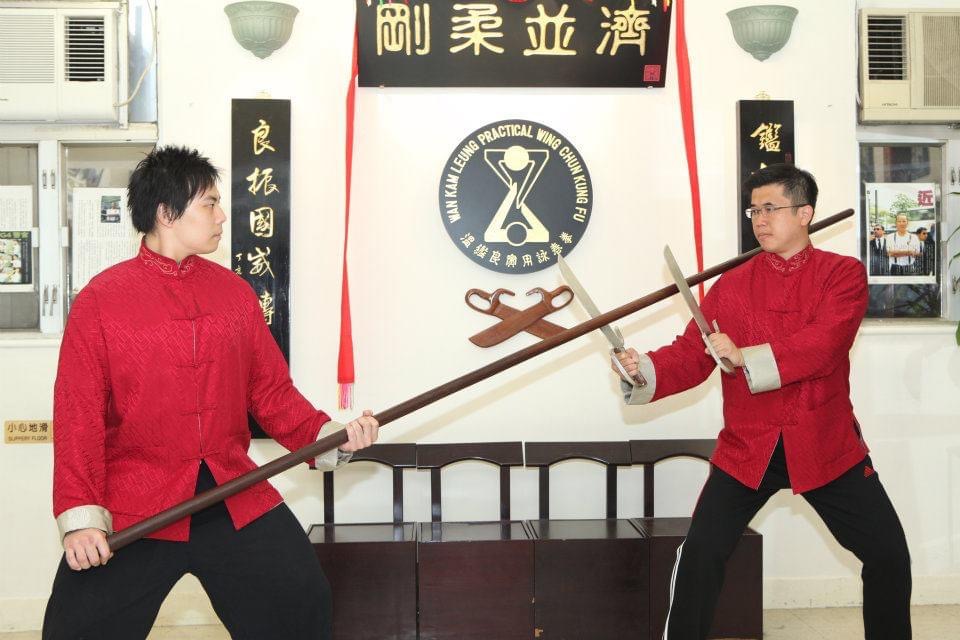
These experience deepened his commitment. Danny immersed himself in Practical Wing Chun and eventually became a full-time instructor at the Hong Kong headquarters of our Sifu, Grandmaster Wan Kam Leung. He spent eight years there teaching group classes, private students, and practitioners who came to Hong Kong from different parts of the world to train.
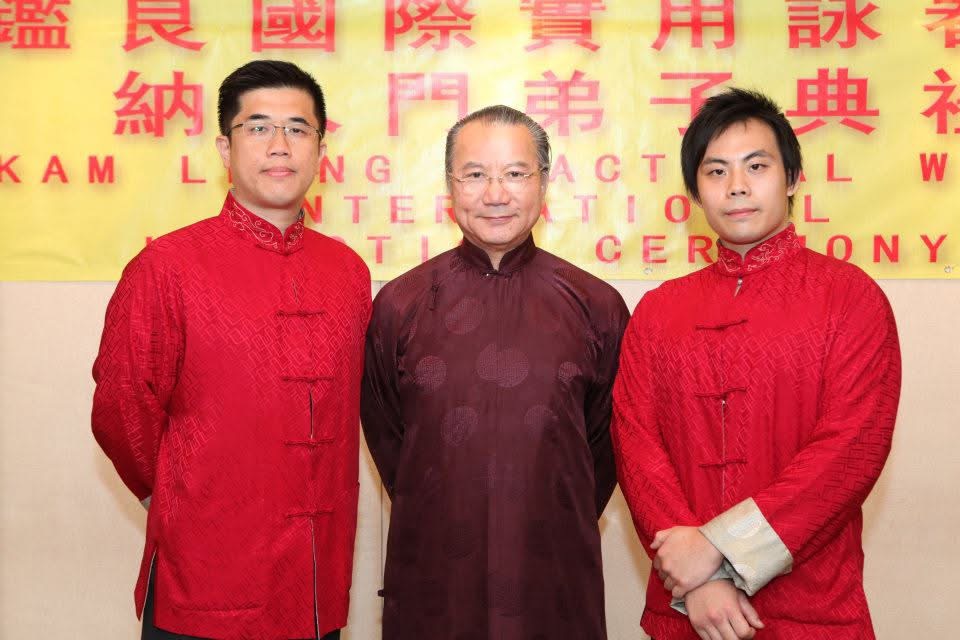
Our paths were parallel, but they kept converging. In 2011, Danny and I formally became inner disciples of our Sifu in the same Bai Si ceremony. Around the same period, we were both appointed senior instructors and were interviewed together for a martial arts magazine for the first time. I still remember how excited we were.
We had become kung fu brothers, but we had not yet discovered what that would really mean.
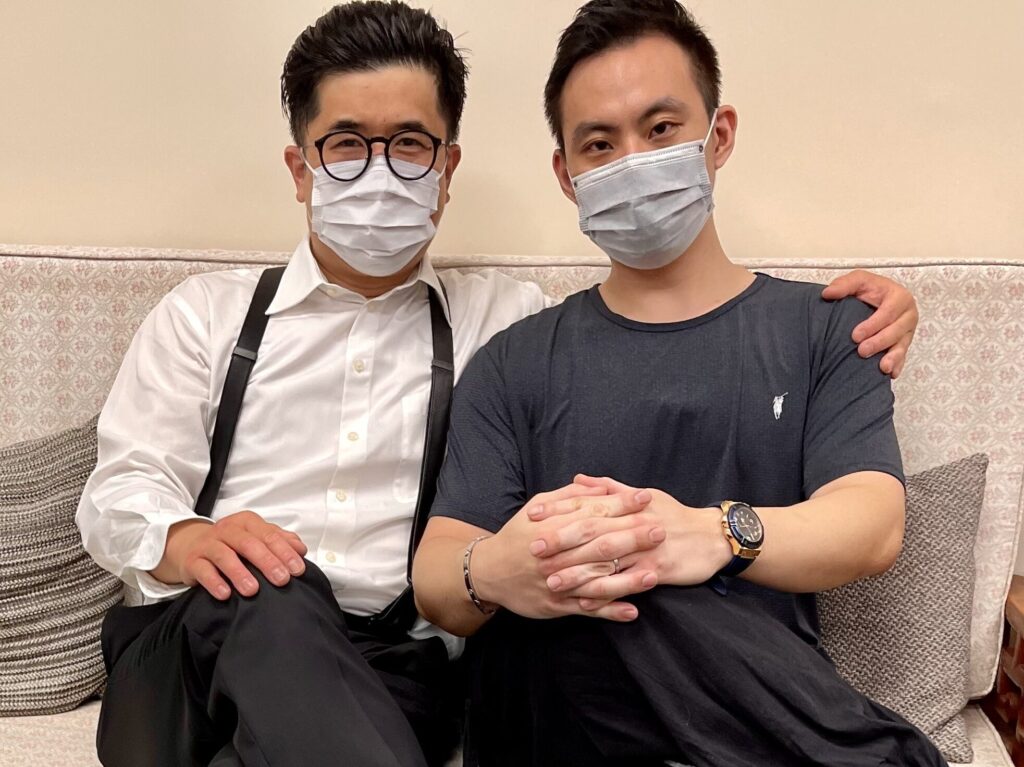
Every Few Months, Hong Kong
For much of the next decade, Danny and I were learning in very different environments. I was living and teaching in New York while he remained in Hong Kong, deeply immersed in Practical Wing Chun. Every few months, when I returned to Hong Kong, one of the things I looked forward to most was getting together with Danny and seeing what had changed.
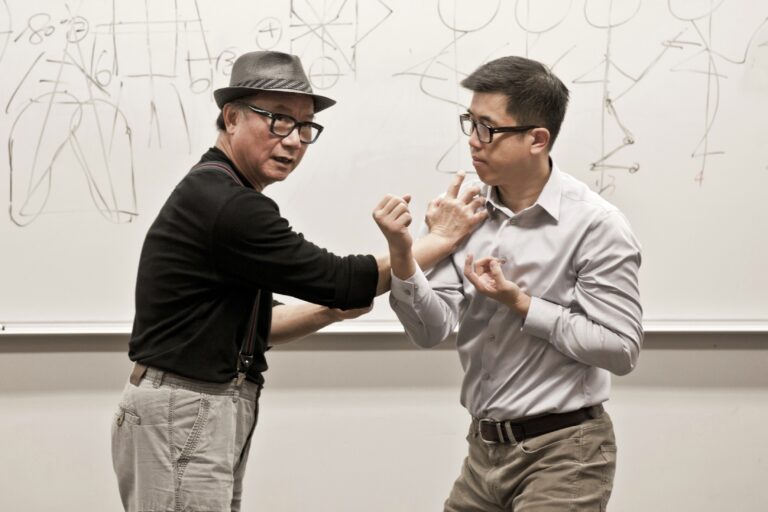
There was rarely any ceremony to it. One of us would bring up something we had been thinking about, perhaps a change in angle, a question about distance, or a problem that kept appearing in teaching. Then we would test it in practical application.
Sometimes an idea worked. Sometimes it survived only a few seconds before the other person found the weakness in it. Quite often, one of us would expose something the other had missed, we would laugh, and then immediately put our hands back up and try again.
Those sessions were serious without always feeling serious.
On one visit to Hong Kong many years ago, I brought Danny an idea I had been developing through my teaching in New York. I thought the angle had closed the center. Danny tested it for a moment, then asked, “What happens if I pivot from here?” When he did, the pressure shifted, my elbow opened, and the space I thought I had taken away was suddenly there again. When we changed the distance, however, that same response created a different problem for him. We adjusted, argued about what had happened, and tried again.
By the end, neither of us had simply proved the other wrong. The idea had become more precise because two different experiences had been allowed to test it.
That difference between us mattered. In New York, I was teaching students with different backgrounds, body types, and previous martial arts experience. My years in other systems also meant that I often approached a Practical Wing Chun question from another angle. Danny, meanwhile, had spent years working from deep inside Practical Wing Chun, training it and teaching it every day.
Later, after leaving his full-time teaching position, Danny also broadened his experience through exchanges with practitioners of other martial arts. Those encounters gave him new ways to question movement, distance, timing, and power.
By then, our conversations had moved beyond simply reproducing what we had been taught. We were trying to understand why something worked, when it worked, and what happened when the conditions changed. We did not always agree, and that was part of the value.
Every few months, we brought different questions back to the same pair of hands.
Over time, I stopped thinking of those sessions as simply training together. We were helping each other think through the body. An idea had to survive contact, timing, resistance, uncertainty, and another person who was free to disagree with it.
We did not simply train together. We changed each other.
Beyond the Training Floor
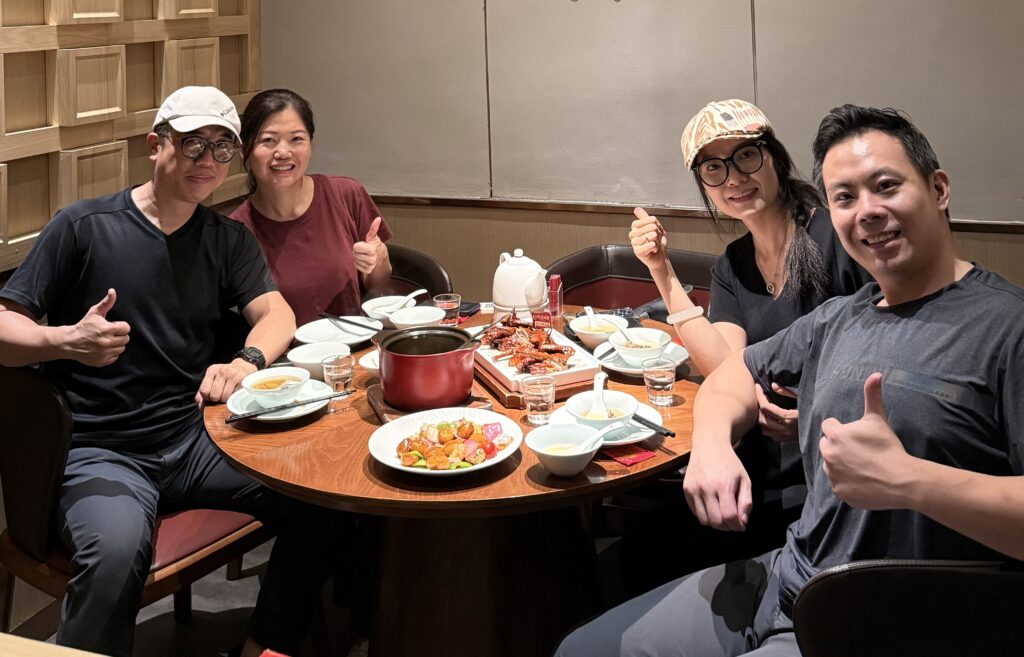
Over the years, my relationship with Danny became less defined by what happened when we put our hands up. Whenever my family and I returned to Hong Kong, he was no longer simply the person I arranged to train with. We would have meals together, catch up, laugh, and talk about whatever had happened since my last visit. Martial arts was always somewhere in the conversation, but it was no longer the only reason we were together.
I saw that change most clearly through my son. Danny would take him out, spend time with him, and look after him with the ease of an older brother or uncle. There was nothing to practice and nothing to prove. It was simply part of the relationship that had grown around all those years of training.
Then, during the COVID-19 pandemic, my father passed away. A memorial service was held for him at the Chinese University of Hong Kong. Danny was in mainland China at the time, during a period when entering Hong Kong required weeks of hotel quarantine. He knew what coming would require, and he came anyway.
The memorial service lasted only a few hours. To be there, Danny spent weeks in quarantine.
There was no seminar waiting for him, no training session, and no kung fu obligation that required his presence. He simply wanted to be there at one of the most difficult moments of my life. I have never forgotten that.
Kung fu gives us many names for relationships. We have teachers, students, seniors, juniors, disciples, and kung fu brothers. In the beginning, those words describe where we stand within a tradition. After enough years, their meaning is tested somewhere else, when there is no training, no rank, and nothing to gain.
Somewhere along the way, a training partner became family.
Still Showing Up
That visit to Zhuhai brought many of those years into focus. I was not simply looking at a new school. I was looking at the next stage of a journey I had watched at close range for more than twenty years.
Danny was now deciding how to pass on what all those years had taught him.
For years, I had returned to Hong Kong and found Danny ready to test whatever questions I had brought back. This time, I had gone to Zhuhai to support him as he began something new.
Soon afterward, Danny came from Zhuhai to Hong Kong to attend a Bai Si ceremony in which I formally accepted a new inner disciple. By coincidence, the ceremony fell on the fifteenth anniversary of our own Bai Si.
In 2011, Danny and I had stood together as we became inner disciples of our Sifu. Fifteen years later, as I accepted a new inner disciple of my own, Danny was there again.
There was no need for a grand conversation about what it meant. For years, Danny had been the person standing across from me, someone I could test an idea with, argue with, laugh with, learn from, and return to after months apart.
Somewhere along the way, he had also become the person standing beside me.
What We Discover Together
We talk a great deal in martial arts about what is passed down from teacher to student. We talk less about what is shaped between people who grow side by side.
Today, knowledge is easier to access than ever. We can study movements from almost every angle and exchange ideas with practitioners around the world. All of that has value. But some understanding still requires another person.
Danny could resist an idea, expose its weakness, surprise me, or make me reconsider something I thought I understood. I could do the same for him. That kind of learning required time, trust, disagreement, and years of showing up.
Some knowledge is taught. Some is discovered together.
If you have trained long enough, there may already be someone whose hands helped shape yours, whose questions sharpened your own, and whose presence became part of your life.
Who’s your Danny? Ω